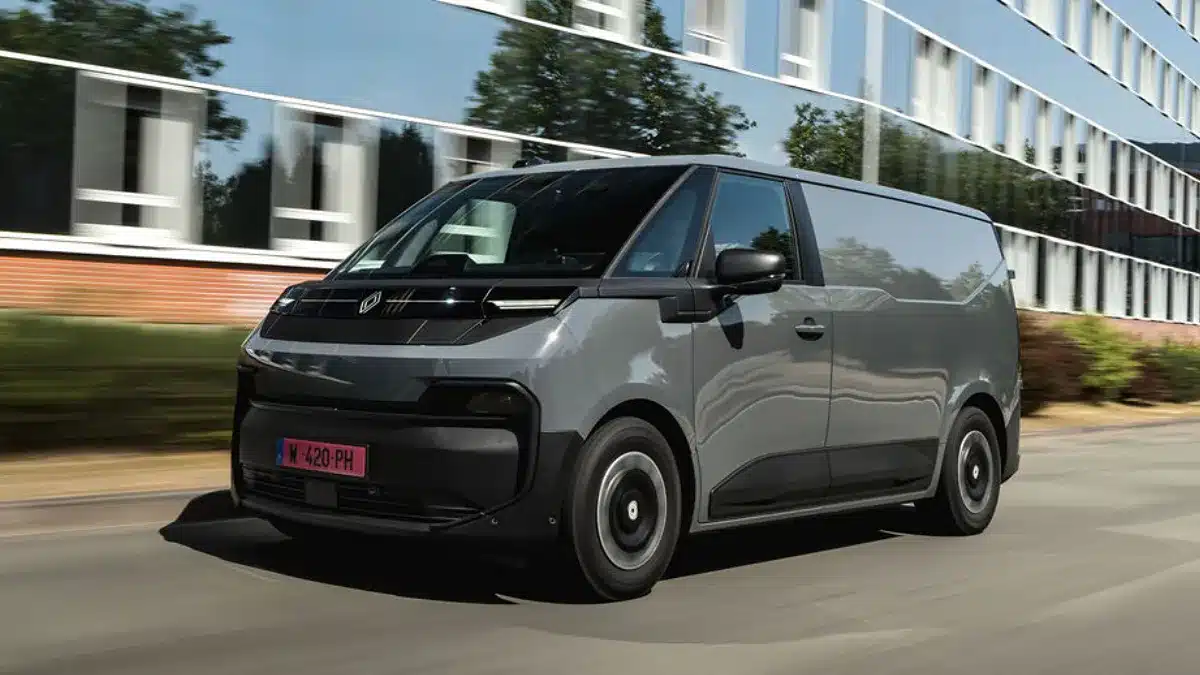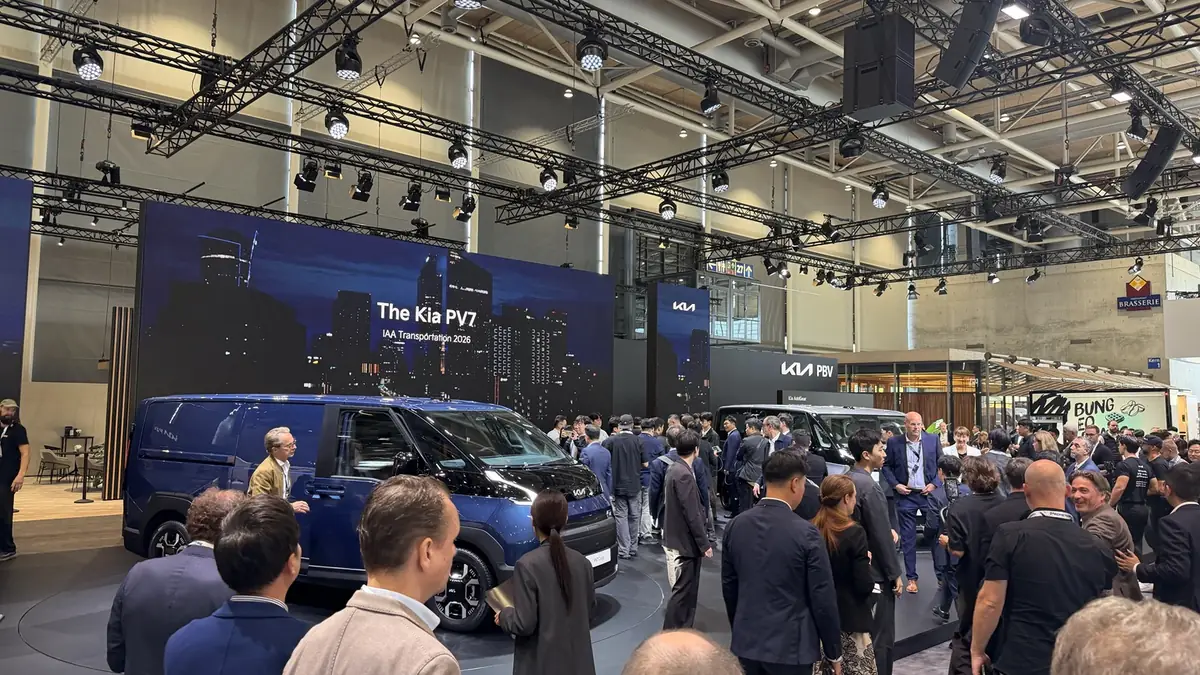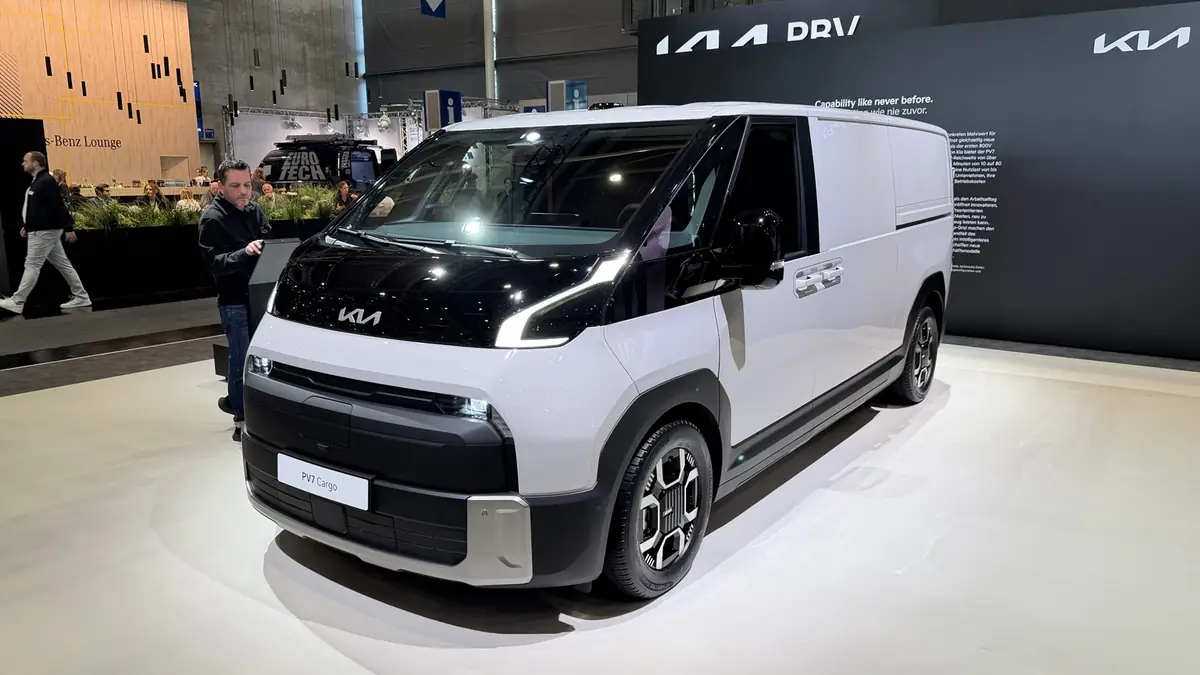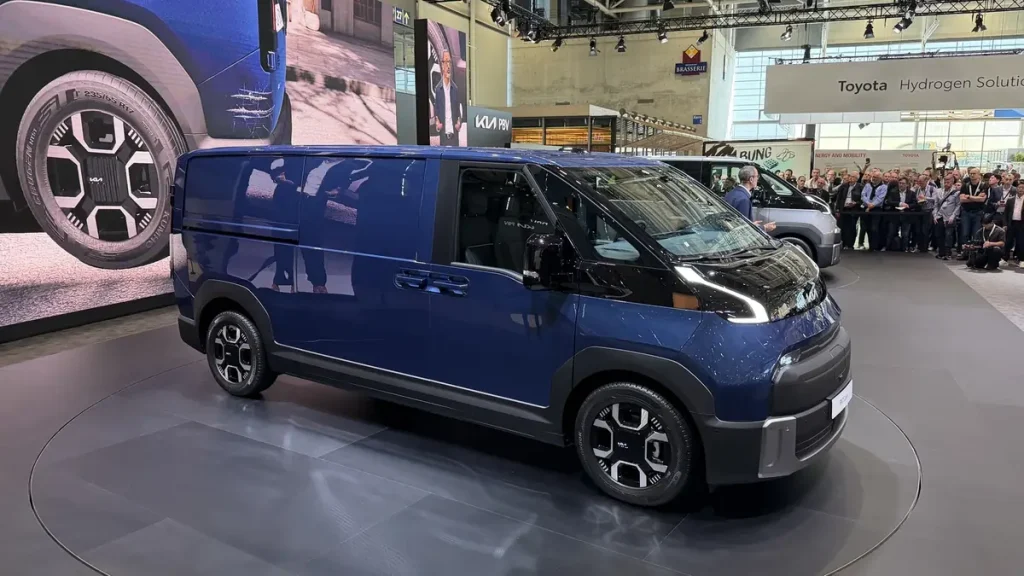
Kia has unveiled the new PV7 electric van, its larger follow-up to the PV5 and the second model in the manufacturer's Platform Beyond Vehicle (PBV) range.
Making its world debut at IAA Transportation 2026 in Hanover, the Kia PV7 will launch in Europe and Korea during the second half of 2027, initially in Cargo and Passenger versions.
It's larger than the PV5 and the new PV7 is aimed squarely at the heart of the medium electric van market, offering up to 8m³ of load volume, payloads of as much as 1,200kg and a claimed WLTP range of more than 460km.
It also introduces 800V electrical architecture to Kia's commercial vehicle range, enabling significantly faster charging.
Read our Kia PV5 review
Two battery capacities will be offered: 71.5kWh and 96.2kWh. Depending on market and specification, the electric motor produces up to 200kW – equivalent to around 272hp – and 420Nm of torque.
Front-wheel drive will be standard at launch, although Kia has already confirmed that an all-wheel-drive PV7 will follow.
Read the full article on What is the Kia PV7 battery, range and charging speeds
The longest-range Cargo model is expected to achieve more than 460km, or approximately 286 miles, under the WLTP test cycle.
The PV7 moves to an 800V electrical architecture and Kia says a 10-80% charge should take somewhere in the mid-20-minute range when connected to a 350kW DC charger, although that figure remains subject to final confirmation.
In an unusual move, Kia is also introducing two charging-port locations.
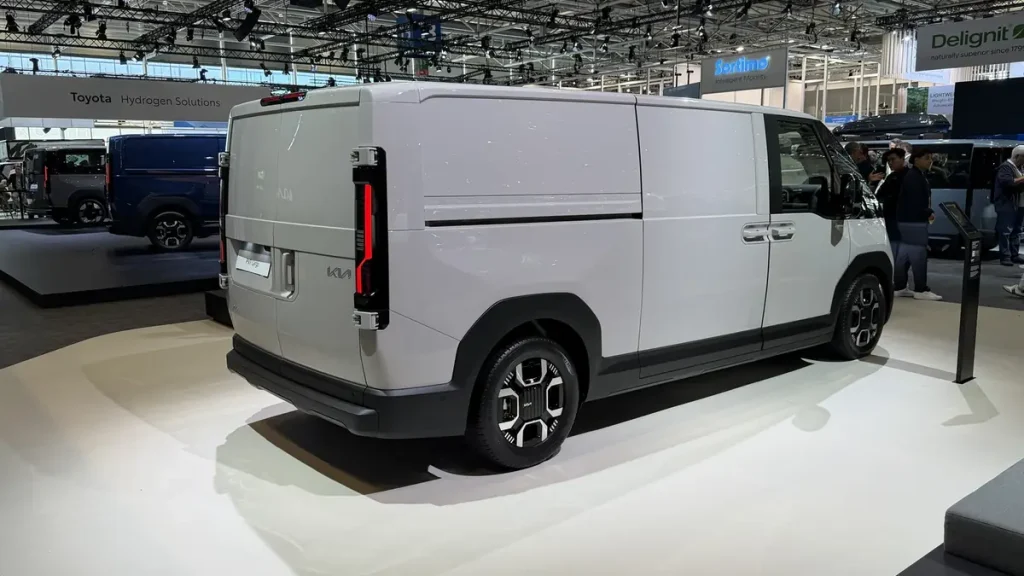
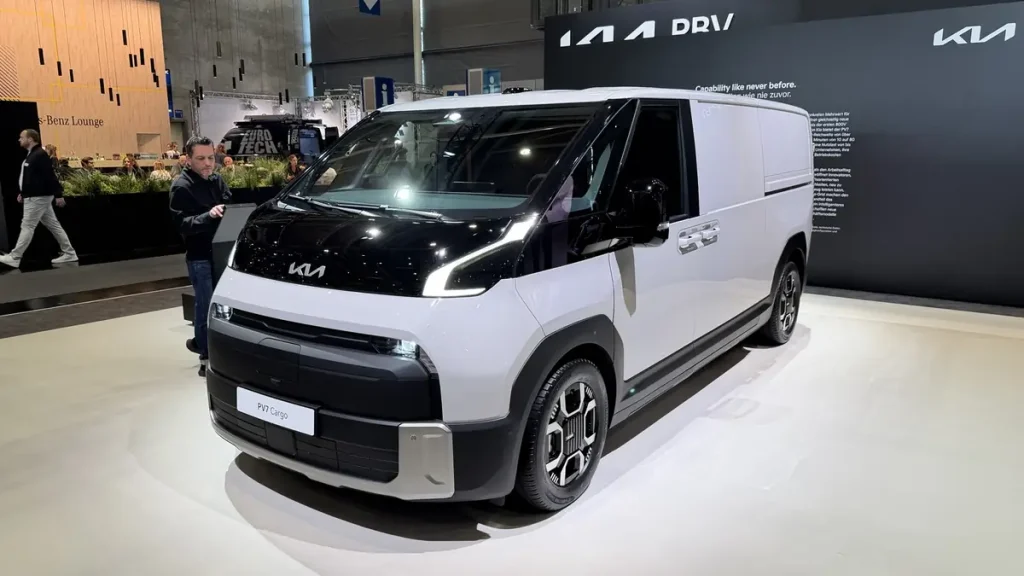
There's an AC/DC charging connection at the front of the vehicle, while an additional AC port can optionally be installed towards the rear.
The idea is to make charging easier regardless of how a van is parked at a depot, loading bay or public charger.
Vehicle-to-Load functionality is also available, allowing the traction battery to power tools and other electrical equipment.
The Long version measures 5,350mm long, 1,995mm wide and 1,990mm high, with a 3,500mm wheelbase. That translates into considerably more carrying capacity than the smaller PV5. PV7 Cargo Long has up to 6.1m³ of load volume, while the High Roof increases that to 8m³.
Read our complete guide to the Kia PV7 dimensions
Maximum payload is as much as 1,165kg in the Long and 1,200kg in the Compact. The Long also has a 550mm loading height and Kia says it can accommodate three Euro pallets.
Cargo versions will be available with two or three front seats and eventually in Compact, Long and High Roof forms.
Customers will also be able to choose between twin rear doors and a conventional lift-up tailgate.
The Passenger version can accommodate up to nine people in global markets and as many as 11 in Korea.
A seven-seat version uses Kia's Long-Rail Easy Remove Seats, allowing the cabin layout to be altered according to how the vehicle is being used.
Kia is putting considerable emphasis on the software behind the PV7. Its Pleos Connect infotainment system is based on Android Automotive OS and includes an app marketplace, over-the-air updates and Gleo AI voice assistance.
Commercial operators will also have access to Kia's Business Solutions Portal, fleet management services, connected vehicle APIs and Uptime services using monitoring and predictive diagnostics.
Kia describes the PV7 as a "business-tailored tool", rather than simply a larger electric van and the range will become considerably larger after launch as it intends to create 23 PV7 variants, including Cargo, Passenger, Chassis Cab and converted vehicles.
The PV7 will go on sale in Europe and Korea during the second half of 2027, with further derivatives and markets following later.