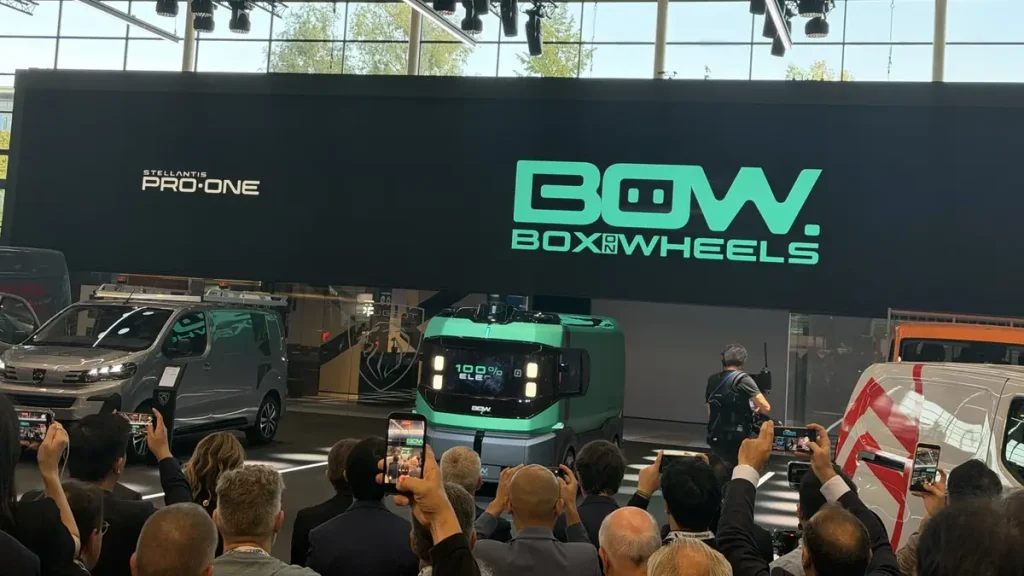
Stellantis has unveiled a fully electric, autonomous delivery vehicle called Box-on-Wheels, designed to transport goods through cities without a driver.
Revealed at IAA Transportation 2026 in Hanover, the Box-on-Wheels has been developed by Stellantis Pro One together with UQI Robotics, a specialist in artificial intelligence, robotics and autonomous driving technology.
The modular vehicle can be fitted with different bodies, with Stellantis demonstrating both enclosed box and flatbed versions, and is being developed for applications ranging from parcel and food deliveries to healthcare, industrial sites, airports and wholesale distribution.
Unlike a conventional autonomous van, Box-on-Wheels has effectively been designed from scratch around not having a driver. There is no cab, windscreen or conventional driving position, leaving almost the entire footprint available for carrying goods.
“Box-on-Wheels. What we see here today is a teaser. It anticipates a part of our future,” said Eric Laforge, Global Senior Vice President of Stellantis Pro One.
Developed initially as a concept, Box-on-Wheels will now be used to investigate how autonomous commercial vehicles can be deployed outside China, where the technology is already being used in some logistics operations.
What is Stellantis Box-on-Wheels?
At its simplest, Box-on-Wheels is exactly what its name suggests: an autonomous electric platform capable of carrying different types of load body.
Stellantis showed the concept operating at IAA Transportation and says the modular platform can support different configurations depending on the job.
That could allow an enclosed body to be used for parcel or food deliveries, for example, while a flatbed version could transport goods around industrial sites.
It is fully electric and designed to recharge overnight, while autonomous driving technology allows it to navigate without an onboard driver.
Stellantis sees particular potential for locations where conventional trucks and vans are restricted or where relatively predictable routes make autonomous operation easier.
Factories, hospitals and airports are among the examples highlighted by the manufacturer, alongside urban last-mile deliveries.
Why is Stellantis developing an autonomous delivery vehicle?
Autonomous commercial vehicles are already being deployed in China, and Stellantis is using its partnership with UQI Robotics to explore whether the same technology can be adapted for other markets.
UQI Robotics specialises in AI, robotics and autonomous logistics systems and has already deployed thousands of autonomous robots.
Stellantis says the collaboration combines UQI’s autonomous driving technology with Pro One’s experience in commercial vehicles, fleet operations and servicing.
“While autonomous urban commercial vehicles are already becoming a reality in China, this collaboration allows us to evaluate how such technologies could be adapted to other markets and customer needs,” Laforge said.
Box-on-Wheels is therefore not being presented as an imminent replacement for the traditional delivery van.
Instead, Stellantis describes it as a concept that opens up potential new logistics applications.
Laforge said those could include “logistics, health, industrial goods, the food chain, the wholesale market and so on”.
No cab means more space for carrying goods
Removing the driver fundamentally changes the way a commercial vehicle can be packaged.
Traditional vans have to devote a substantial proportion of their overall length to a cab containing seats, steering controls, airbags, heating and ventilation systems and the other equipment needed by a driver.
Box-on-Wheels does away with that requirement.
The result is a vehicle whose footprint can be devoted much more heavily towards its actual load.
Its modular construction could also allow different bodies to be fitted to the same underlying vehicle architecture.
Stellantis has not yet released detailed specifications for the concept, including its dimensions, payload, battery capacity, range or maximum speed.
Those figures will ultimately be important in determining what sort of work a production version could realistically undertake.
Could Box-on-Wheels replace delivery vans?
Not in the immediate future.
Box-on-Wheels remains a concept and Stellantis has not announced a production date or confirmed that it will ultimately be sold commercially.
Instead, the vehicle is intended to investigate the potential for autonomous logistics and the types of operation where removing the driver could provide a genuine benefit.
The most obvious early applications are likely to be controlled environments.
Factories, warehouses, airports and large industrial sites potentially provide a simpler operating environment than busy public roads, particularly where vehicles repeatedly travel between fixed locations.
Last-mile urban logistics could be a considerably bigger prize.
Stellantis used the launch to demonstrate the idea of autonomous vehicles carrying parcels, flowers and food through urban areas, potentially accessing locations where larger commercial vehicles are increasingly restricted.
Box-on-Wheels forms part of bigger Stellantis van offensive
The autonomous concept was revealed as Stellantis outlined a much wider expansion of its commercial vehicle business.
Stellantis Pro One currently estimates that its products allow it to compete in around 70% of the potential commercial vehicle market.
It wants to increase that figure to 90% through a major product offensive involving new platforms and vehicles.
Future platforms will support electric and internal combustion powertrains, with Stellantis also putting a much greater emphasis on hybrid commercial vehicles.
The company is planning 11 new commercial vehicle models globally by 2030, including two new generations of vans and a new multi-energy mid-size pick-up platform.
Alongside conventional vans, Stellantis is also expanding into smaller forms of urban commercial transport, including the Fiat Tris electric three-wheeler.
Box-on-Wheels pushes that strategy significantly further.
When will Stellantis Box-on-Wheels go on sale?
For now, it won’t. Stellantis describes Box-on-Wheels as a concept and has not announced a production timetable, price or final technical specification.
But its decision to demonstrate a working vehicle at IAA Transportation – rather than simply showing a design study – provides a much clearer indication of the direction Stellantis is investigating.
It is also a radically different interpretation of what a future Stellantis commercial vehicle could look like.
The company already produces everything from car-derived vans and compact LCVs to large vans and motorhome base vehicles.
Now it is considering whether some future commercial vehicles need to look like vans at all.
As the deliberately uncomplicated name suggests, once you remove the driver, the commercial vehicle can become something much simpler: a box on wheels.