The Transit range is massive these days but while most of the difference comes in trim, size or power, the Ford E-Transit Custom AWD stands out as something a bit different.
The four-wheel-drive electric Transit Custom is not only a bit niche for your average bricky or delivery driver, it’s also a bit niche for 90% of owners or fleets in Europe.
But for those that need to either stray off road a bit, or live in particularly challenging climates, like the Nordic countries, the twin motors and 4x4 driveline of the E-Transit Custom AWD create a van that’s a little out of the ordinary.
It's not going to be for everyone, but if you regularly go off-road because maybe you fix wind farms for a living or perhaps you own a Scottish retreat halfway up Ben Nevis, then this is the van for you.
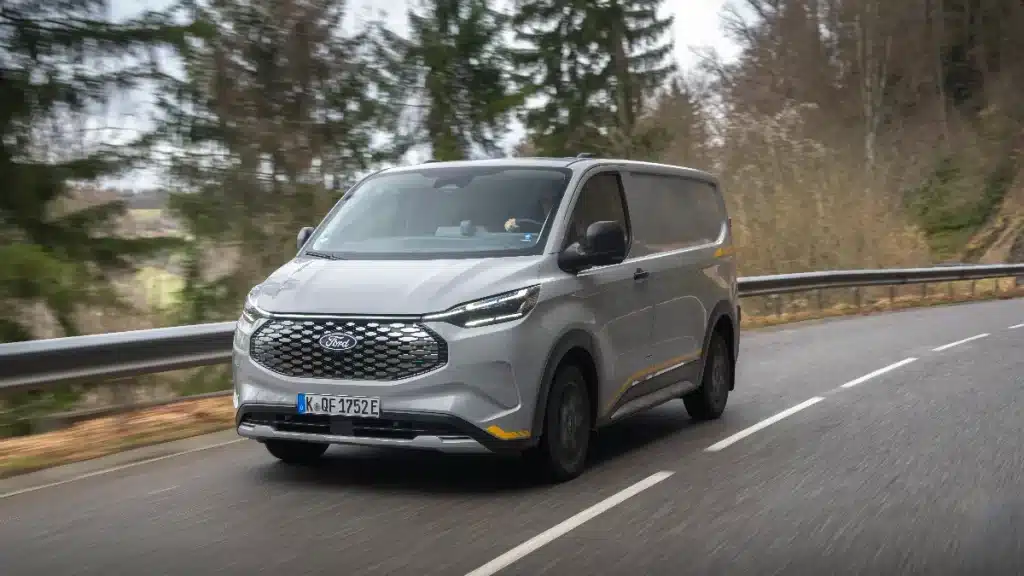
We'll start with what's changed across the E-Transit Custom family for 2026, because there have been some headline upgrades, most notably around faster DC charging and improved efficiency.
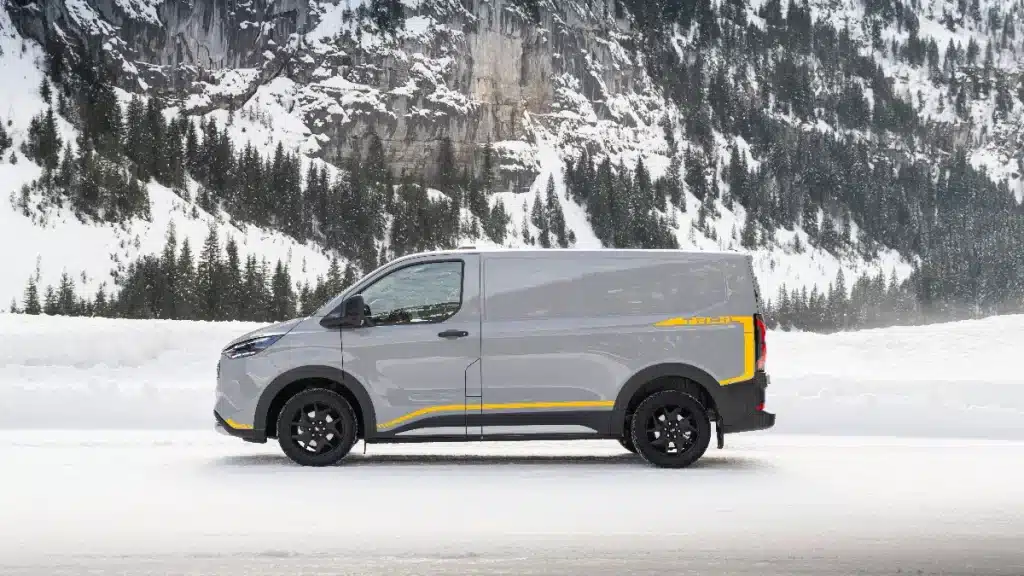
We’ll start with the basics, AWD stands for all-wheel-drive, so this is the 4x4 version of the electric Custom.

The standard electric version of the E-Transit Custom is rear-wheel-drive, but Ford designed the latest Transit Custom ahead of its launch to not only be electric but to have twin motors. That means that the all-wheel-drive E-Transit Custom gets two identical motors front and rear.
The mad part, however, is that both motors can deliver maximum power, so you can have 100% at the rear or 100% at the front and any combination in between.
Power can also be pulled side to side to individual wheels, so that’s front-to-back and side-to-side power distribution. Not a bad party piece.
Like the regular rear-wheel-drive range there are 100kW, 160kW or 210kW motor options, that give you plenty of choice over just how much power you want to put into your gravel track or icy road.
It’s not just a question of outrageous power distribution, though. There’s also torque. Lots of torque. There’s a total of 630Nm on tap and up to a maximum of 415Nm can be sent to each motor.
Ford chief programme engineer Andy Fells tells us that the learnings behind the E-Transit Custom All-Wheel-Drive have come directly from models like the Bronco and the F-150 Lightning, so while you can’t have either of them in the UK you can get a taste of what they’re capable of thanks to the eAWD system.
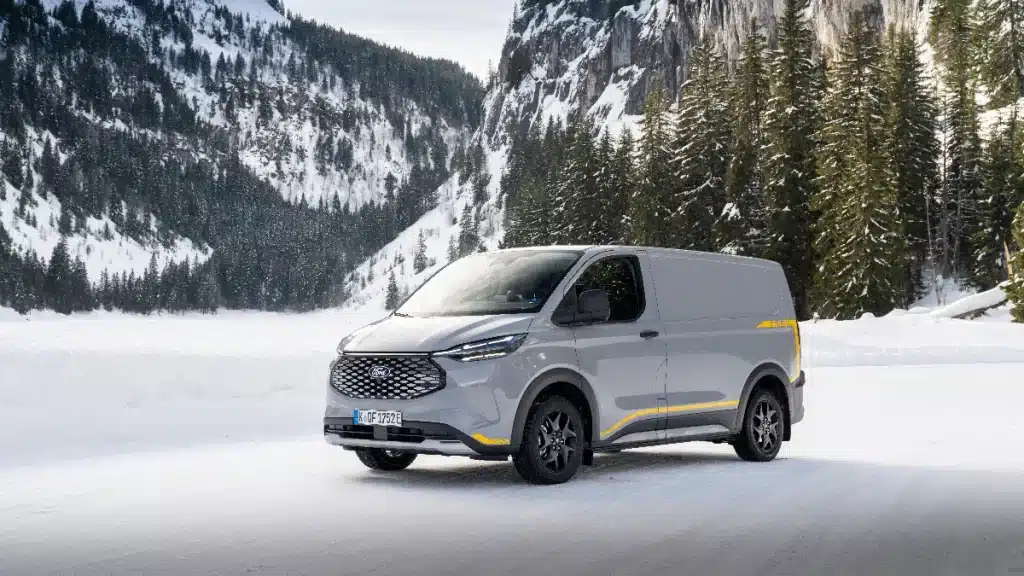
There’s naturally also developments and insights taken from the Ford Ranger as well, and they’ve put the 4x4 E-Transit Custom through its paces at their proving ground in Belgium, on gravel track roads, and on ice and snow during extensive testing in Finland.
It has then, very much, been designed around traction. How to put power down and how to safely keep it there.
It’s not an off-roader though, as there’s no lifted ride height and trick suspension. Instead it’s best described by Fells as an “all-weather” van.
Where better to test its all-weather suitability than on the roads, of the French Alps, amongst the chalet and ski lifts of the region near Chamonix, and on a purpose-built ice track normally home to Porsches, Subarus and Alpines.
Out on dry salted roads the AWD E-Transit performed unflappably, taking in the changes conditions of grippy asphalt and treacherous icy patches in the shadows.
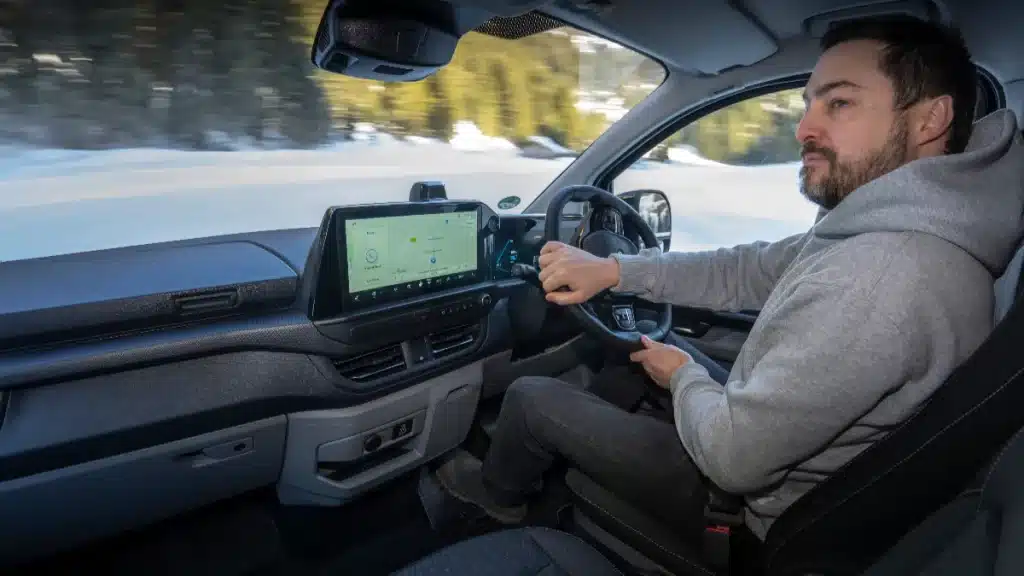
Having driven multiple versions of the Transit Custom as both a BEV and ICE van, we found it almost no different. However, that abundance of power is immediately noticeable, especially if you’re overly keen on the throttle.
Taking a trip in the most powerful 210kW in Sport trim, we found it aggressively fast but also utterly manageable.
The power shifts around unnoticeably beneath you, so while you might bury the accelerator pedal, the traction control simply juggles the power, adjusting its load across all four wheels, up to 50 times per second.
The result is that while we could see the traction control light working, we barely noticed the interruption in power.
In short. This thing is lightning quick whatever you are trying to do with it.
Here is your lightly refined version with the awkward phrasing and structural issues smoothed out, but without changing your tone or intent.
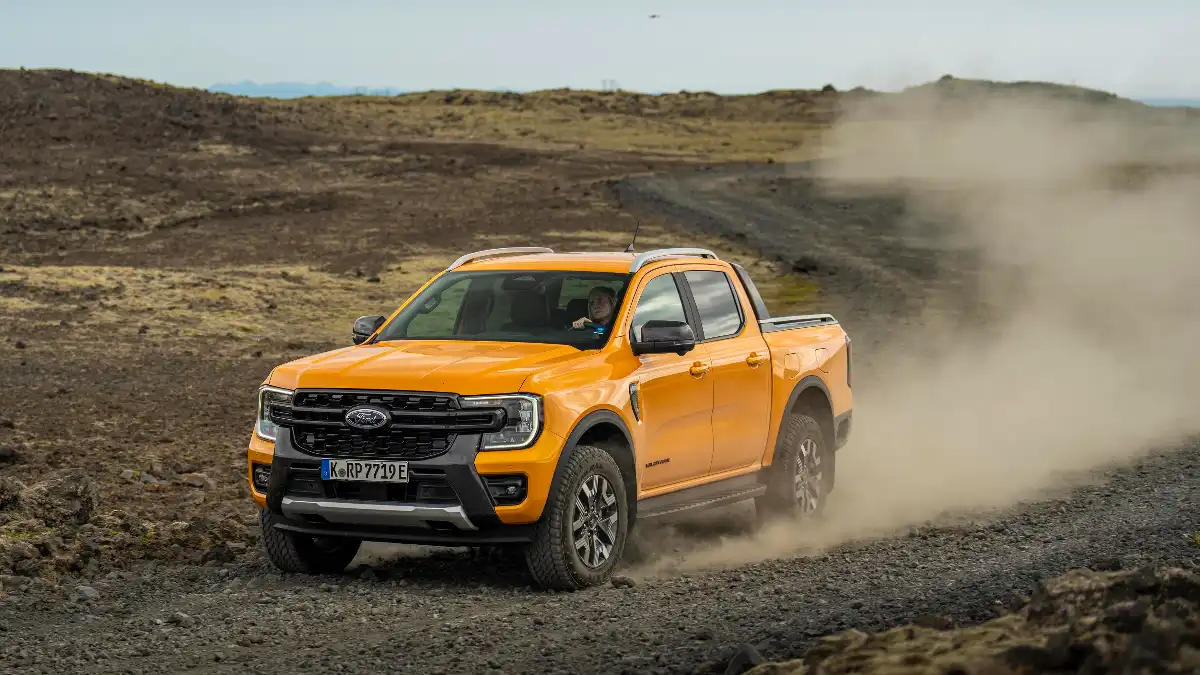
Firstly, it’s important to note that this isn’t an off-roader. If you want to go full off-road then we’d suggest looking at a Ranger or another pick-up truck, but the E-Transit Custom AWD is very much a go-most-places all-terrain van.
Where the diesel model uses a Haldex coupling to send power to the rear axle, the electric Transit starts as rear-wheel drive. Ford has simply added an additional motor to the front to give you two driven axles.
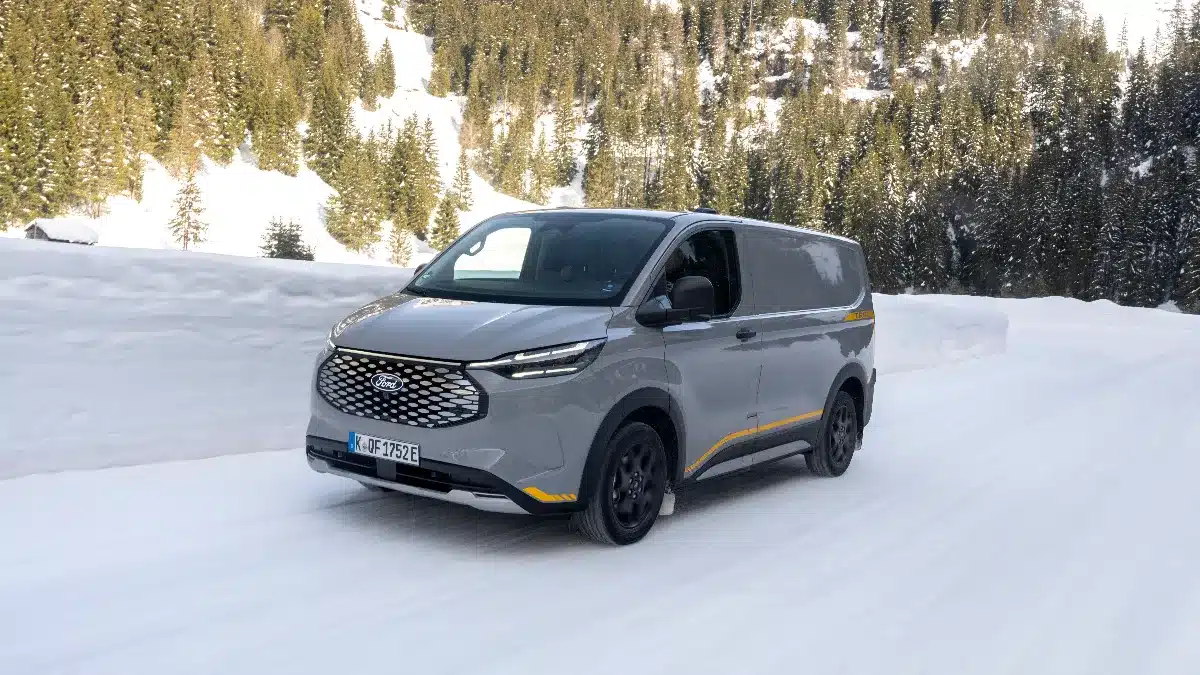
The result is a hugely capable medium van that inspires confidence even on really tricky surfaces. As you’ll see from the pictures, we spent a lot of time testing the all-wheel-drive electric Custom on snow and ice, and its abilities were immediately evident as soon as we began exploring the various drive modes.
Starting in Normal, we could see how restrictive the traction control was, constantly killing power and almost forcing you to crawl along. Even at slow speeds there was very little grip, and the van struggled on turn-in and under braking.
The obvious choice for conditions like this is Slippery mode. Power is distributed more evenly between the four wheels and traction control is less aggressive. It’s still nannying, but it allows you to make safe and sensible progress.
Unique to the AWD is Trail mode, a halfway house between slip and control, which in these conditions is reminiscent of the Ford Ranger Raptor’s Baja mode. When testing the Raptor, we found Baja mode to be the ultimate thrill setting, giving enough leniency in the traction and stability systems to execute outrageous slides. Trail isn’t much different here and actually proved to be the more relaxing mode to drive in.
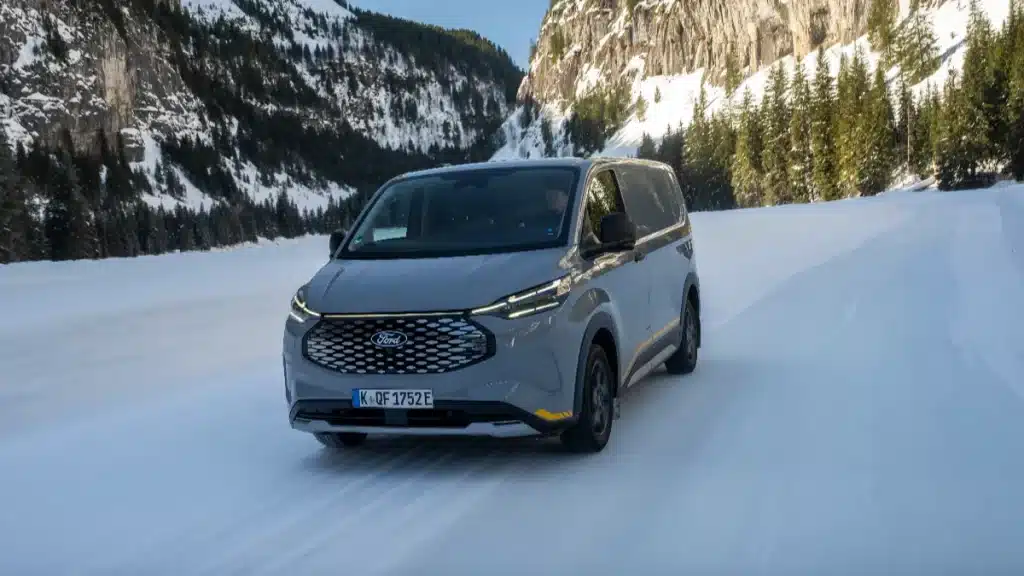
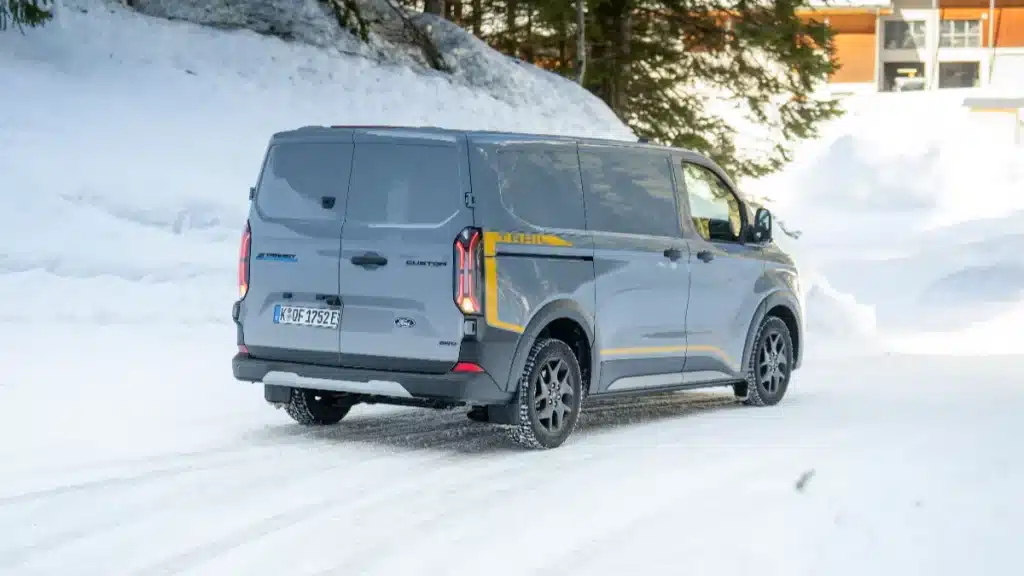
Trail mode allows a small amount of wheel slip, helping to disperse the loose surface so the tyres can bite in and generate better traction.
Think of it like driving uphill on a gravel road: if the wheels start spinning, instead of cutting the power, Trail allows controlled slip in the hope that those pesky pebbles are pushed aside and grip improves.
On snow and ice it works well, letting you put the power down regardless of the terrain beneath you.
Grip levels are also aided by a clever new system called Split-mu, with “mu” representing a measurement of traction. When we stopped on a low-grip surface, the system was able to direct power to whichever individual wheels had the most traction. Rather than sending power across an entire axle, as in conventional traction control, the E-Transit Custom AWD can apportion power wheel by wheel. This is where the 50 calculations per second come in, constantly adjusting how much torque each wheel receives.
As well as testing the AWD on an ice track, we took it on a road trip across some twisty mountain roads, the sort of terrain more suited to a supercar than a van. With patches of ice lurking in every shaded section, the AWD proved to be a safe pair of hands, gently and almost imperceptibly adjusting power if you entered a bend too hard or hit a hidden icy patch.
Naturally, this made our test drive rather uneventful. Not what you want for a review, but definitely what you want as a punter.
The E-Transit Custom AWD uses the same interior as the regular van, so there are no surprises here — it remains a comfortable and practical place to spend time.
There are supportive seats, excellent visibility and a natural driving position. We named both the Transit Custom and the E-Transit Custom in the Van Reviewer Awards as the best medium vans in their respective diesel and electric categories. The AWD builds on that strength, extending the van’s usability to a broader audience.
With a basic E-Transit Custom currently costing £43,630, the uplift of £5,000 doesn't seem like all that much considering what you're getting.
An extra motor, and a truly capable van at less than an additional 12% doesn't seem all that bad when you put it like that, but it does mean that you've suddenly got quite an expensive van.
With the entry-level E-Transit Custom AWD costing £48,630 (ex VAT) for the 100kW Trend trim, your basic price can soon spiral if you look at the plusher Limited at £50,180.
Want to add more power? The 160kW option will cost £51,820 for the Limited trim, and £53,020 for the very cool Trail trim picutred here, and £53,720 for the Sport model.
If you're really looking to maximise your appearance, and minimise your bank balance, then the MS-RT version will set you back a staggering £65,490. If you're unlucky enough to have to then pay the VAT you're looking at a van costing nearly £81k by the time it's on the road, delivered and taxed. Ouch.
We'd avoid the MS-RT unless you really want to make an impact, but the Trail trim does give you that distinctive look at a much nicer price point.
As we mentioned at the beginning, if you regularly go off the hard standing then the E-Transit Custom AWD is ideal.
It's immensely capable and it provides a warm cosy safety net for anyone who's worried they might either get themselves stuck or find themselves in treacherous conditions.
Whether you need all-wheel-drive will probably come down to just how "all-weather" you need to be in your daily driving, but if push comes to shove we can't think of any other product that comes close to the capability of the E-Transit Custom AWD.
Read the Volkswagen ID Buzz Cargo review
Some food for thought is that you could get an ID Buzz Cargo, but it's smaller, and Volkswagen will of course eventually offer the Volkswagen Transporter as a Transporter 4Motion, but until then, this is your best bet. There's also a vast range of models to choose from, which you likely won't get with the Transporter.
One final thing to consider. The Transit Custom is available in all-wheel-drive and with a diesel engine. So while the power delivery and response of the electric motors makes it a very different proposition to the EV, you're not limited to this as a powertrain.
The £41,490 starting price for the diesel Transit Custom AWD also saves you more than seven grand, and is cheaper than even the standard rear-wheel driver electric van. We're not saying that's what you should do, but its certainly a more cost-effective option.
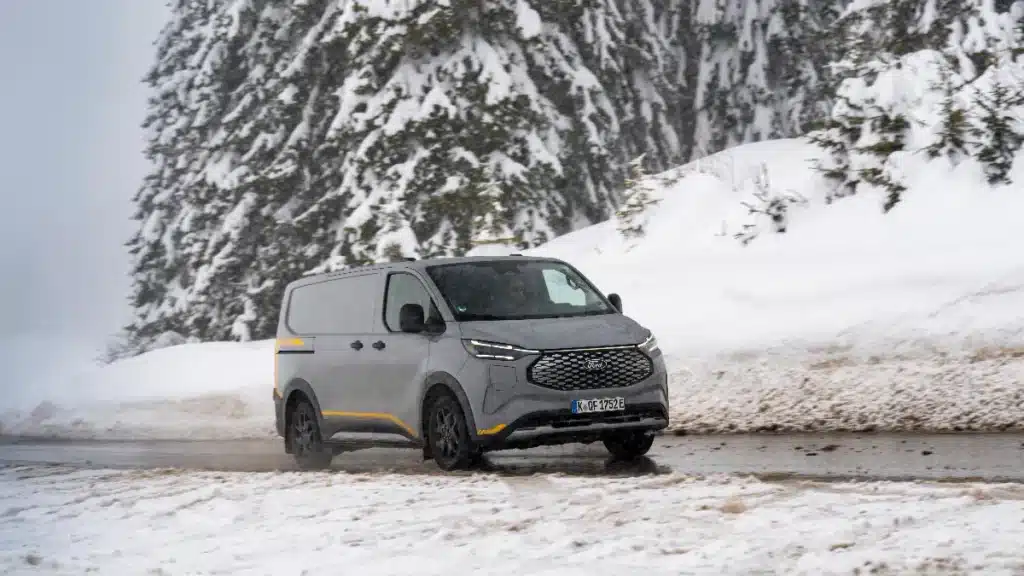
The system uses two independent electric drive units – one powering the front axle and one the rear. It monitors wheel slip up to 50 times per second and automatically adjusts torque between the axles in real time. If the rear wheels lose grip, full torque can be directed to the front wheels instantly. Unlike mechanical AWD systems, there is no physical linkage between axles, allowing faster and more precise responses.
The dual motors work alongside traction control and electronic stability control systems to distribute power between front and rear axles. The system can also apply braking to individual wheels to maintain grip. It continuously monitors steering input and road conditions to reduce oversteer or understeer, helping keep the van stable on wet roads, loose gravel or uneven surfaces.
The E-Transit Custom AWD is an all-electric version of Europe’s best-selling van featuring a dual-motor, all-wheel drive system. From early 2026, it adds enhanced traction, stability and towing capability, alongside a new battery pack for improved range and faster charging.
The 210 kW AWD version produces a combined 630 Nm of motor torque from a standstill. That is more than 50 per cent higher than the rear-wheel drive model, helping with fully loaded hill starts and towing. The 210 kW powertrain is exclusive to Sport and MS-RT variants.
AWD is available across multiple body styles including panel van, Kombi, double-cab-in-van and multiCab. It can also be specified in fiver different trims. Trend, Limited, Trail, Sport and MS-RT.
Yes. The Ford E-Tourneo Custom also offers AWD with either 160 kW or 210 kW drive units, depending on trim. Available series include Active, Sport, Titanium X and MS-RT.
Yes. At lower speeds, such as urban delivery driving, the AWD system can use regenerative braking from both drive units. This allows up to 50 per cent more regenerative braking force compared with the RWD version, helping optimise efficiency.
The AWD model includes dedicated modes for challenging conditions:
Slippery Mode – Minimises wheel slip on wet, icy or muddy roads to maintain control and momentum.
Trail Mode – Allows controlled wheel slip on loose surfaces such as gravel or sand for more predictable progress.
The E-Transit Custom AWD model can tow up to 2,300 kg (braked), making it suitable for heavy trailers, plant equipment or specialist conversions.